

Most companies reach a point where in-house recruitment simply cannot keep up with what the roles demand. Roles these days pile up faster than the team can fill them, candidate quality starts to slip, and the cost of reactive hiring compounds in the background. For many Indian businesses, this is the moment they start exploring Recruitment Process Outsourcing.
RPO is not a new concept globally, but its adoption in India has accelerated significantly in recent years, thanks to the rapid headcount growth in tech, SaaS, fintech, and AI sectors where the demand for specialist talent consistently outpaces internal hiring capacity. There are different models when it comes to RPO – and understanding what they involve, and whether it suits your organisation, is worth researching properly before committing to a single model.
This guide covers everything you need to know about Recruitment Process Outsourcing
What Is RPO in Recruitment?
Recruitment Process Outsourcing, or RPO, is when a company transfers all or part of its recruitment function to an external service provider. The RPO partner acts as an extension of the internal HR team, taking ownership of the hiring process from job briefing through to offer and onboarding, rather than simply filling individual vacancies on an ad hoc basis.
The key difference that separates RPO from traditional recruitment agencies is the fact that agencies just fill a seat, while an RPO partner manages the hiring process end-to-end. The relationship is longer term, more embedded, and designed to improve the quality and efficiency of hiring systematically rather than reactively.
RPO providers typically work on-site, off-site, or in a hybrid model, and the scope of what they own varies depending on the arrangement. Some organisations outsource their entire talent acquisition function. Others outsource only specific parts of it, such as sourcing, screening, or high-volume hiring for a particular division.
The Different RPO Models
Understanding the models available is important because RPO is not a one-size-fits-all solution. The right model depends on your hiring volume, the complexity of your roles, and how much internal capacity you already have.
- End-to-end RPO: This is the most comprehensive model where the provider takes full ownership of recruitment across all roles and levels, from workforce planning and job briefing through to offer management and onboarding. This works best for larger organisations with consistent, high-volume hiring needs across multiple functions.
- Project RPO: This is a time-bound engagement where the provider manages recruitment for a specific initiative, such as a product launch, a geographic expansion, or a bulk hiring drive. Once the project is complete, the engagement ends. This model suits businesses that have a defined spike in hiring need without a long-term requirement for outsourced support.
- Selective RPO: Sometimes called modular RPO, involves outsourcing only specific stages of the recruitment process. A company might retain ownership of final interviews and offer management while outsourcing sourcing and screening entirely. This is particularly useful for businesses that have strong internal hiring capabilities in some areas but genuine gaps in others.
- On-demand RPO: It provides flexible support that scales up or down based on immediate hiring demand. It is the most flexible model and works well for growing businesses whose hiring needs are difficult to predict quarter to quarter.
How RPO Works in Practice
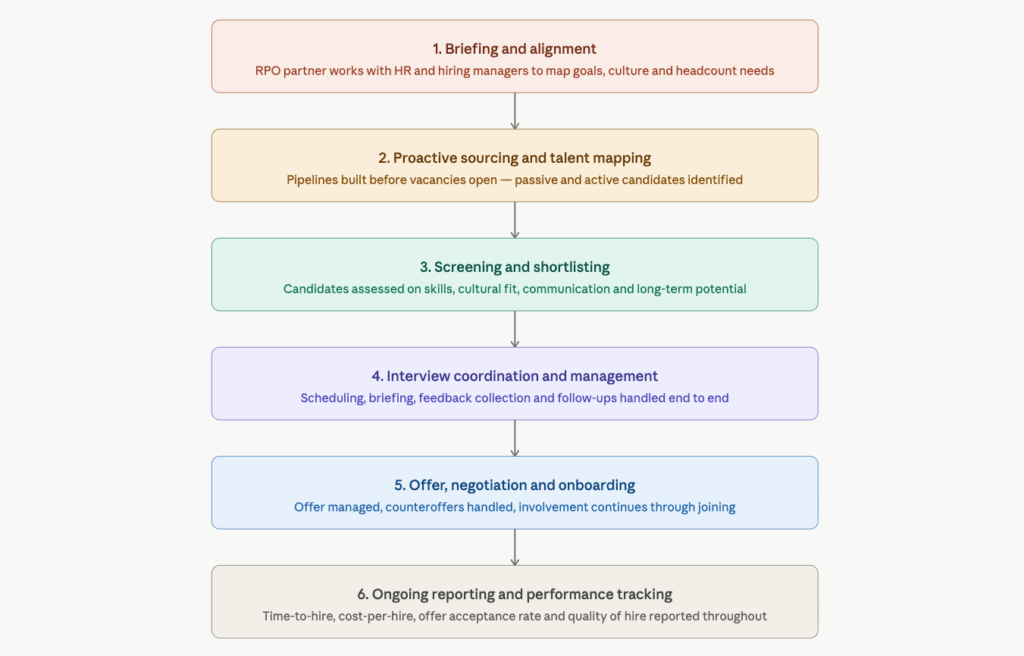
The mechanics of an RPO engagement vary by provider and model, but the core workflow follows a consistent pattern.
It begins with a detailed briefing process where the RPO partner works closely with hiring managers and HR leadership to understand the organisation’s goals, culture, current hiring challenges, and upcoming headcount requirements. This is not a one-time conversation, but an ongoing alignment that underpins every hiring decision that follows.
From there, the provider takes ownership of sourcing, building talent pipelines proactively rather than responding to vacancies after they open. Screening and shortlisting are conducted against a defined framework, with candidates assessed on skills, cultural fit, communication, and long-term potential rather than CV keywords alone.
Interview coordination, feedback management, and offer negotiation are then handled by the RPO team, with the client’s hiring managers focusing their time on final decisions rather than process administration. Post-hire, many RPO providers stay involved through onboarding to protect the investment made in securing each candidate.
Throughout the engagement, the RPO partner reports on key metrics, time-to-hire, cost-per-hire, offer acceptance rate, and quality of hire, giving the organisation visibility into hiring performance in a way that most internal teams struggle to maintain consistently.
Beyond recruitment delivery, experienced RPO providers also help organisations build more structured and compliant hiring processes. While the legal responsibility for complying with Indian employment laws ultimately remains with the employer, an RPO partner can reduce recruitment-related risks by maintaining consistent documentation, standardised interview processes, background verification workflows, and legally compliant hiring practices. For organisations hiring across multiple states or at scale, this additional layer of process governance can significantly reduce administrative errors and improve recruitment consistency.
Why Indian Businesses Are Turning to RPO
India’s hiring landscape has specific characteristics that make RPO particularly relevant right now. The volume of applications generated by a single job post can get overwhelming. The gap between the skills companies need and the talent that is actively available is significant, particularly in AI, machine learning, and enterprise software. And the cost of a bad hire, estimated at 30% of annual salary and often considerably more in practice, means that speed without quality is not a solution at all.
RPO addresses all three of these challenges simultaneously. It brings process rigour to high-volume environments, specialist knowledge to complex talent markets, and accountability to a function that is easy to deprioritise when business teams are focused on delivery.
There is also a cost argument. Building and maintaining a strong internal talent acquisition team is expensive, particularly when hiring demand fluctuates. RPO converts a largely fixed internal cost into a variable one that scales with actual need, which is financially significant for startups and scale-ups operating in uncertain market conditions.
RPO vs Traditional Recruitment Agencies: What Is the Difference?
This is a question that comes up consistently, and it is worth answering directly because the two are often conflated.
A traditional recruitment agency works on individual mandates, which means you give them a vacancy, they find candidates, they fill the role, and they charge a placement fee, typically a percentage of the hired candidate’s salary. The relationship ends when the seat is filled. There is limited process ownership, limited reporting, and limited accountability for what happens after the candidate joins.
RPO on the other hand is a fundamentally different commercial and operational arrangement. The provider is embedded in your hiring function, not parachuted in for individual placements. They are measured on the whole process – pipeline quality, hiring velocity, and retention, not just placements made. The commercial model of RPO is usually based on a management fee or cost-per-hire rather than a percentage of salary.
For organisations with consistent hiring volumes and a desire to improve recruitment as a function rather than just fill individual seats, RPO is the more strategic choice. For businesses with occasional, one-off requirements, a specialist agency often makes more sense.
Key Metrics to Evaluate RPO Performance
If you are working with an RPO provider, or evaluating whether to, these are the metrics that matter most.
- Time-to-hire measures the number of days from job brief to accepted offer. In India’s tech sector, the industry average sits at 45 to 60 days. A strong RPO provider should consistently beat this, particularly for roles where they have existing talent pipelines in place.
- Quality of hire is assessed at 90 days, six months, and twelve months through hiring manager satisfaction scores and performance data. This is the most important long-term measure of whether the RPO engagement is delivering genuine value.
- Cost-per-hire includes all associated costs: provider fees, job board spend, interview time, and onboarding. Tracking this against a pre-RPO baseline shows whether the engagement is delivering the financial efficiency it promised.
- Offer acceptance rate should consistently be above 80%. Anything lower suggests problems with candidate experience, compensation benchmarking, or the quality of expectation-setting during the process.
- Hiring manager satisfaction is often overlooked but highly revealing. If the people closest to the roles feel the process is working, the partnership is in good shape. If they do not, the metrics alone will not tell you why.
Potential Challenges of RPO
RPO is not without its complications, and going in with clear expectations prevents the most common disappointments.
Starting with the transition period – handing over recruitment to an external partner requires knowledge transfer, process alignment, and time for the provider to understand your culture and talent requirements properly. Rushing this phase almost always leads to early friction.
Cultural fit between the RPO provider and your organisation matters more than most companies anticipate. A provider that does not genuinely understand your employer brand or your team dynamics will struggle to represent you convincingly to candidates, particularly for senior or specialist roles where fit is as important as capability.
There is also the question of internal resistance. HR teams can feel threatened by RPO arrangements, particularly if the scope of the engagement overlaps significantly with existing roles. Managing this transition carefully and communicating the rationale clearly from the outset makes a meaningful difference to how well the partnership beds in.
Finally, not all RPO providers are equal in their sector knowledge. A provider with deep expertise in FMCG hiring may not be the right partner for a fintech company building an AI engineering team. Sector fit matters, and it is worth evaluating this rigorously before signing any agreement.
Is RPO Right for Your Business?
RPO tends to work best in specific situations. If your organisation is hiring at volume across multiple roles simultaneously, if your internal team is stretched and reactive rather than strategic, if your time-to-hire is consistently long, or if the quality of candidates reaching final interview stages is not where it needs to be, RPO is worth serious consideration.
It is less suited to businesses with very low hiring volumes, highly niche requirements that demand deep domain expertise the provider cannot match, or organisations where the internal HR team is already performing strongly and simply needs occasional specialist support for specific roles.
The honest question to ask is whether your current recruitment process is a competitive advantage or a constraint. If it is consistently slowing you down or costing you good candidates, an RPO model has a strong case. If it is working well and the requirement is occasional, a specialist recruitment partner is likely a better fit.
At CareerFit, we work across both models. For clients with consistent, structured hiring needs, our end-to-end RPO service embeds our AI platform and specialist recruiters directly into your talent acquisition function. For clients with specific or project-based requirements, we operate as a specialist partner on individual mandates. The right answer depends on where you are and where you are going.
Summary
RPO is a mature, well-evidenced model for organisations that want to move from reactive hiring to a structured, accountable recruitment function. In India’s competitive talent market, where the best candidates are off the market in under two weeks and a single bad hire can cost far more than most companies budget for, the case for investing in a proper hiring infrastructure is increasingly hard to ignore.
Whether full-scope RPO or a more selective engagement is right for your business, the starting point is the same: honest clarity about where your current process is working and where it is not.
CareerFit specialises in end-to-end recruitment and RPO for businesses across India’s specialist hiring markets. If you are building a team and want a partner who understands the landscape, get in touch.